

Communication Project Planning Guide
How to plan successful communication projects from first brief to final delivery.
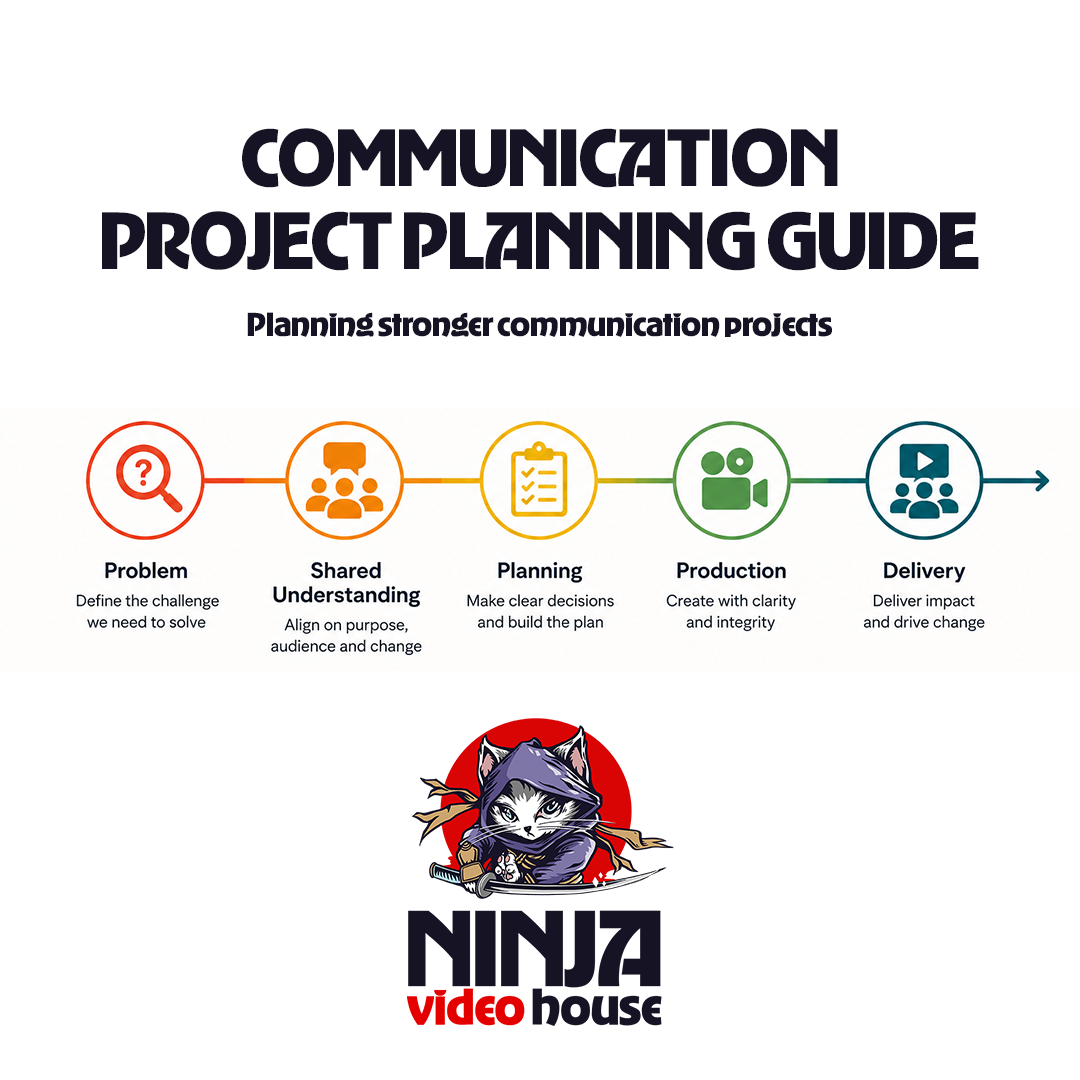
Every communication project begins with a conversation.
Sometimes it's a marketing campaign that needs explaining. Sometimes it's a policy change, a recruitment challenge or a new initiative that people simply aren't engaging with. Someone eventually says, "We should probably make a video."
By that point, dozens of decisions have usually been made already.
The project has a purpose. People have expectations. Stakeholders have opinions about what success should look like. Some of those expectations are shared. Others exist only in someone's head.
Production inherits all of it.
At NINJA video house, we've come to think about production a little differently.
Production exists to preserve the integrity of an idea as it passes through many hands.
That idea isn't about protecting the first draft or resisting change. Good projects improve as more people contribute. Better ideas emerge. Practical constraints reshape the approach. New information appears.
The challenge is something else.
As projects move through organisations, it's surprisingly easy for the original purpose to become blurred. Decisions still get made. Everyone remains busy. Progress is visible. Yet the project gradually starts answering a different question from the one it set out to solve.
By the time that becomes obvious, the cameras are usually rolling.
This guide isn't about filmmaking.
It's about the decisions that shape communication projects before, during and around production. They're the decisions that quietly determine whether production becomes a process of refinement or a process of recovery.
They're also the decisions we've seen make the greatest difference over the years.
Why this guide exists
Most communication projects don't fail dramatically.
They become harder than anyone expected.
A timeline stretches by another week.
A new stakeholder appears during the second review.
Feedback starts arriving through emails, meetings and phone calls instead of one place.
Everyone is trying to help. Nobody is trying to make the project more complicated.
It just happens.
If you've managed communication projects for any length of time, you've probably experienced some version of this already.
Production often gets blamed because that's when these issues become visible.
Our experience has been that they usually started much earlier.
Not because somebody made a terrible decision.
More often because a series of perfectly reasonable decisions slowly moved the project away from a shared understanding of what it was trying to achieve.
That's why this guide spends very little time talking about cameras, editing or production techniques.
Those things matter.
The conversations before them usually matter more.
Four ideas that appear throughout this guide
Over time we've found ourselves returning to the same patterns.
We didn't set out to create a framework. These ideas simply gave us language for things we'd been seeing repeatedly.
Idea Integrity
Every project starts with a fairly clear picture of what success looks like.
Then more people become involved.
Someone raises a risk nobody had considered.
Another stakeholder suggests an opportunity.
The audience changes.
The brief evolves.
None of this is unusual. In fact, it's healthy.
What matters is whether the project still feels like it's solving the same problem.
We've come to think of that as Idea Integrity.
It's less about protecting the original idea than preserving the reason it existed in the first place.
Shared Understanding
There are projects where everyone signs off the brief and still walks away imagining slightly different outcomes.
You don't notice immediately.
The differences appear later, often during script reviews or rough cuts, when two reasonable people discover they approved the same document with different expectations.
The paperwork wasn't the issue.
The shared understanding was.
Briefs, scripts, storyboards, schedules and review processes all have practical uses, but they also do something quieter. They help people make decisions from the same picture of the project.
Project Drift
Projects rarely go off course all at once. They drift.
There's usually no single meeting where everything falls apart.
Instead, priorities shift a little.
An approval is delayed.
A new objective finds its way into the brief.
A stakeholder joins late with information everyone wishes they'd had earlier.
Individually, these moments feel manageable.
Collectively, they change the direction of the project.
After seeing this pattern enough times, it helps to have a name for it.
We call it Project Drift.
Production Readiness
Every production reaches a moment where someone asks whether it's time to begin.
Sometimes that question comes because the planning is complete.
Sometimes it comes because the shoot date is approaching.
Those aren't always the same thing.
Production Readiness isn't really about the calendar.
It's about recognising when the project has developed enough shared understanding that production can keep moving forward without constantly stopping to redefine what it's trying to achieve.
Before engaging a production company
Most production companies will ask about budget, timelines and deliverables fairly early.
Those conversations are important, but they're much easier once the project itself is reasonably well understood.
You don't need every answer before engaging a production company. That's part of our job.
You do need enough shared understanding that everyone is trying to solve the same problem.
The questions below have consistently made the biggest difference.
1. What problem are we trying to solve?
It's surprisingly common for a project to begin with the solution.
"We need a video."
That might turn out to be true, but it isn't the place to start.
The more useful conversation is usually about whatever prompted someone to suggest a video in the first place.
Has something changed?
Is there confusion?
Has engagement fallen?
Is an important message simply not getting through?
Sometimes the answer is a video.
Sometimes it isn't.
Taking the time to define the problem gives every later decision somewhere to return when the project becomes more complicated.
2. What change are we trying to create?
A communication project should leave something different from how it found it.
Perhaps people understand a process more clearly.
Perhaps they're more willing to participate.
Perhaps they feel reassured about a change that's coming.
Sometimes the desired change is behavioural. Sometimes it's simply greater understanding.
Whatever it is, say it plainly.
When projects lose their way, it's often because people can still describe the deliverable but struggle to describe the outcome.
3. Who are we actually trying to reach?
Almost every brief includes an audience.
Not every brief describes one.
"Staff."
"The community."
"Students."
Those groups are often too broad to help anyone make meaningful creative decisions.
Think about a real person instead.
Where are they likely to encounter this communication?
What do they already know?
What assumptions are they bringing with them?
What would need to happen for them to feel the communication was genuinely useful?
Specific audiences don't make projects smaller. They make decisions easier.
4. Who needs to be involved?
One pattern appears often enough that it's worth planning for.
The project progresses well.
The brief is approved.
Filming happens.
The first edit arrives.
Then somebody who has significant decision-making authority sees the project for the first time.
At that point, production is no longer responding to feedback.
It's responding to an entirely different understanding of the project.
That situation isn't usually caused by poor production.
It's almost always the result of important conversations happening too late.
Identifying decision-makers early doesn't eliminate disagreement.
It simply moves the disagreement to a point where it's much easier to resolve.
5. What would success look like?
Ask five people how they'll know the project has been successful.
If you receive five different answers, it's worth pausing.
Success doesn't need to be measured perfectly.
It does need to be understood consistently.
Try describing success without mentioning the video itself.
If the answer becomes clearer, you're probably thinking about the communication rather than the deliverable.
Project Readiness
Eventually every project reaches the point where someone asks:
"Are we ready?"
There's rarely a perfect answer.
Every project carries some uncertainty into production.
The question isn't whether everything has been resolved.
It's whether the remaining uncertainty is something the team can manage while still making good decisions.
We've found a simple checklist useful.
Project Readiness Checklist
Before production begins:
☐ We understand the problem we're trying to solve.
☐ We've agreed on the outcome we're trying to create.
☐ The audience is clearly understood.
☐ The people responsible for key decisions have been identified.
☐ Stakeholders understand how decisions will be made.
☐ Feedback will be consolidated before it reaches production.
☐ The project still feels like everyone is describing the same piece of work.
If most of those statements feel true, production usually becomes much more straightforward.
If several feel uncertain, that uncertainty has a habit of resurfacing later when it's harder and more expensive to resolve.
Where projects begin to drift
Most communication projects don't suddenly go off course.
They drift.
The changes are usually small enough that nobody notices them at the time.
Looking back, the pattern becomes obvious.
Looking forward, it's much harder to see.
These are the situations we've found ourselves encountering most often.
Decision-makers arrive late
Sometimes this happens because everyone assumes someone else has already spoken to them.
Sometimes it's simply the reality of busy organisations.
Either way, the result is similar.
The project develops around one understanding of success.
Later, someone with final authority introduces another.
Neither perspective is necessarily wrong.
They simply haven't been brought together early enough.
Production starts before the thinking settles
Momentum feels good.
Once filming begins, there's visible progress.
Schedules move.
Footage arrives.
Edits begin.
Momentum can also disguise unresolved questions.
Production is very good at building things.
It struggles to build clarity that should already exist.
That's why a little more thinking before production often saves a great deal of work afterwards.
Feedback reaches production before it reaches agreement
Production teams don't need unanimous opinions.
They need clear decisions.
When conflicting stakeholder feedback arrives without first being resolved internally, the production team is left trying to interpret organisational conversations it was never part of.
That isn't really a production problem.
It's an organisational one that's reached production.
The projects that run most smoothly usually have one thing in common.
Internal discussion happens before production receives the outcome.
Every message becomes equally important
Communication projects often begin with one clear objective.
As planning progresses, another worthwhile message appears.
Then another.
Each one feels too important to leave out.
Eventually the project carries far more than it was ever designed to.
Nothing has gone wrong.
The project has simply accumulated expectations.
Audiences don't experience communication that way.
They look for one clear thread to follow.
Deciding what matters most is often more valuable than finding another point to include.
Organisational knowledge stays in people's heads
Every organisation has knowledge that never makes it into the brief.
Sometimes it's the way staff talk about an issue.
Sometimes it's the political context behind a decision.
Sometimes it's a phrase that sounds perfectly normal internally but means something completely different to the audience.
Production teams can't infer that knowledge.
They can only work with what becomes shared.
The strongest projects tend to involve clients who recognise that production expertise and organisational expertise solve different problems.
Both need to be in the room.
Planning creates room for creativity
There's a common assumption that planning and creativity compete with one another.
We've rarely found that to be true.
The projects that feel most creative are usually the ones where the fundamentals became clear early.
People stop debating who the audience is.
They stop revisiting the objective every few days.
They stop asking whether someone important has been forgotten.
That creates room for a different kind of conversation.
The conversation shifts from:
"What are we actually trying to make?"
to:
"What's the strongest way to communicate it?"
That's where creative work becomes genuinely enjoyable.
Not because the process becomes rigid.
Because the uncertainty has moved to the right place.
What production is really preserving
It's easy to think production begins when the cameras roll.
By then, most of the important decisions have already been made.
The project already has a purpose.
It already has an audience.
It already carries expectations about what success looks like.
Production inherits those decisions.
From that point onwards, the work becomes something slightly different.
Every schedule.
Every storyboard.
Every interview.
Every edit.
Every review.
They're all opportunities to either strengthen the original purpose or slowly move away from it.
That's why we've come to think about production the way we do.
Production exists to preserve the integrity of an idea as it passes through many hands.
It's not because ideas shouldn't evolve.
The strongest projects almost always evolve.
It's because that evolution still needs a sense of direction.
Without it, production quietly becomes an exercise in recovering alignment that was lost much earlier.
With it, production becomes what it should be: a process of refining an already well-understood idea.
When that happens, the final communication rarely feels accidental.
It feels inevitable.
Not because it was obvious from the beginning.
Because every important decision continued serving the same purpose.
Continue exploring
This guide introduces several ideas that we'll continue exploring through future Insight articles.
Each one expands on a recurring pattern we've observed across communication projects.
Rather than introducing new theories, they'll explore familiar situations in greater depth.
Future topics include:
Project Drift — why communication projects gradually move away from their original purpose.
Production Readiness — recognising the point where planning has created enough shared understanding for production to begin.
Shared Understanding — why documents don't keep projects aligned, but conversations often do.
Feedback Consolidation — helping production teams execute decisions rather than interpret conflicting opinions.
Decision-Maker Alignment — involving the right people early enough that production can move with confidence.
Together, these articles will build on the same body of professional knowledge introduced here.
If you're planning a communication project and would like to talk it through, we're always happy to have a conversation.
Whether you ultimately work with us or not, we've found that thoughtful planning almost always makes production simpler, communication clearer, and projects easier for everyone involved.
Planning a communication project?
If you’re working through the early stages of a video, campaign or internal communication project, we’re happy to talk it through before production begins.
Start a conversation with NINJA video house.